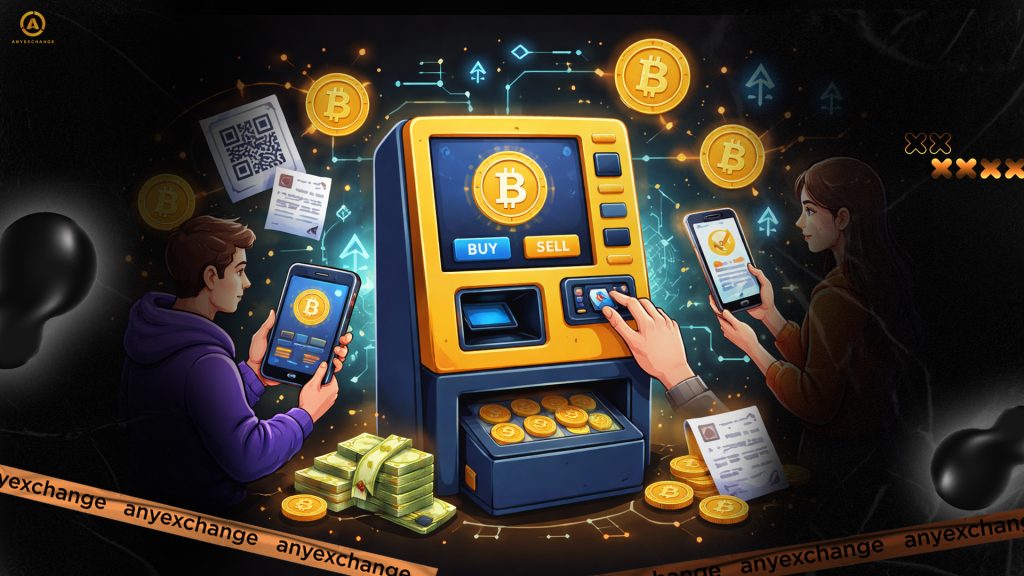
At first glance, Bitcoin ATMs seem like a step backward, a return to cash in an increasingly digital world. However, this is a conscious strategy. Direct offline access ensures availability outside of banking systems and applications while reaching an audience willing to pay more for easier entry into the crypto ecosystem. At the same time, Bitcoin ATMs are a pragmatic business tool. Operators monetize convenience, speed, and cash handling, transforming the concept of decentralized currency into an accessible service with high profit margins.
According to Coin ATM Radar, there are currently about 40,000 Bitcoin ATMs installed worldwide, and this number continues to grow. Now, let’s take a look at what Bitcoin ATMs are, how they work, and whether it is safe to use them in the current environment.
What is a Bitcoin ATM?
A Bitcoin ATM (BTM) is a specialized device designed to buy and sell cryptocurrencies using fiat cash or a debit card, eliminating the need to open a bank account. It is directly connected to the blockchain and processes transactions in real time.
These devices are installed in public places and resemble regular ATMs or payment terminals. The BTM interface consists of a case containing a screen, a bill acceptor, a QR code scanner, and sometimes a card reader. Instructions for using a Bitcoin ATM are usually straightforward, making them an easy way for beginners to interact with cryptocurrency without registering on exchanges.
It is important to understand that a Bitcoin ATM is not just an alternative to a traditional ATM; it is a separate financial instrument with its own fees, limits, and risks. The main difference between Bitcoin ATMs and traditional bank ATMs is that the latter interact with bank accounts and a centralized financial systеm, while the former do not. Bitcoin ATMs directly convert cash into cryptocurrency and vice versa. Therefore, transactions through Bitcoin ATMs are irreversible, and the protections offered by bank cards are absent. Fees for Bitcoin ATMs usually range from 5% to 20%, whereas fees for traditional banking systems rarely exceed 1–3%. For autonomy, decentralization, and the absence of traditional intermediaries, customers pay higher costs and face an increased risk of erroneous transactions.
Most of these machines work not only with Bitcoin but also support several other assets — they belong to the category of crypto ATMs, or cryptomats. Which cryptocurrencies do ATMs support? In addition to Bitcoin, exchanges with Ethereum (ETH), Litecoin (LTC), Bitcoin Cash (BCH), and popular stablecoins are usually offered. The composition of supported assets depends on the operator and jurisdiction. In any case, however, BTC occupies a dominant position, accounting for about half of all transactions through crypto ATMs.
How Bitcoin ATMs work
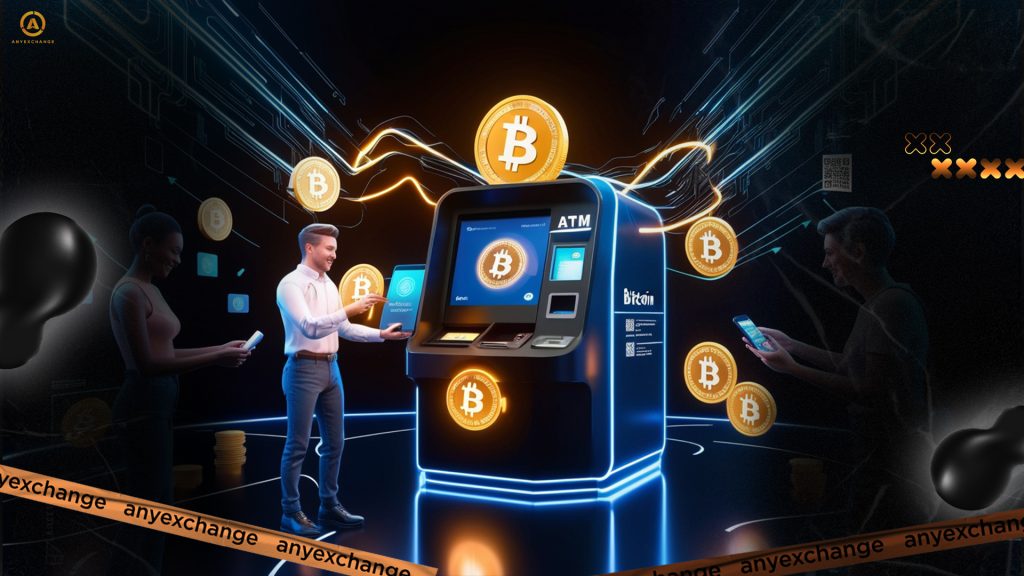
Technically, a Bitcoin ATM works by creating and sending an on-chain transaction to the Bitcoin network. Confirmation takes an average of 10 to 60 minutes, depending on network congestion. In 2026, the average time was reduced to about 20 minutes through commission optimization and the partial use of second-layer solutions.
A crypto wallet is necessary for working with a BTM because it is how users receive or send digital assets. A QR code is also required for interaction and is used to transfer wallet or ATM addresses, which significantly reduces the risk of data entry errors.
The primary use of a Bitcoin ATM is to purchase Bitcoin with cash. Here’s how it works: The user selects the purchase function, scans the QR code of their crypto wallet, and inserts bills into the ATM. The device automatically calculates the equivalent amount of BTC, taking the current exchange rate and commission into account, and sends the funds to the specified address.
When selling Bitcoin through a crypto ATM, the user selects the sell function, receives the ATM address QR code, and sends the required amount of BTC from their wallet to the address. After the transaction is confirmed on the blockchain, the device dispenses cash.
Step-by-step instructions: how to use a Bitcoin ATM
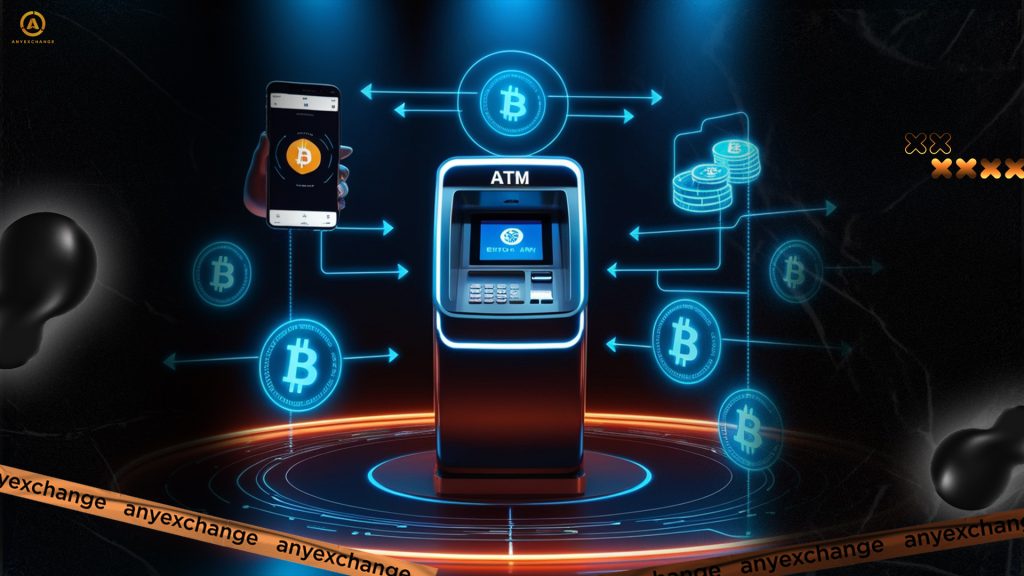
- The first step is to find a Bitcoin ATM nearby. Google offers specialized services and operator websites that display the location of devices, their functionality, and fees. Before buying or selling cryptocurrency through a crypto ATM, it is worth studying the terms and conditions of the particular device and operator.
- When the user is near the device, they proceed with the transaction and open their crypto wallet. The ATM then reads the wallet address QR code to which the funds will be credited or from which the cryptocurrency will be sent. This step is key to ensuring security. Users are advised to verify the first and last characters of the displayed address to prevent substitution or scanning errors.
- When buying, the user inserts cash bills into the ATM receiver. When selling cryptocurrency, the user must confirm the transfer of BTC to the specified address.
- After the transaction is complete, the ATM generates and sends the transaction to the network. The user receives a receipt or electronic confirmation with an ID that can be used to track the transaction’s status in a blockchain explorer.
Commissions and limits
Average Bitcoin ATM commission
Exchanging Bitcoin through an ATM is convenient for quick transactions without the involvement of banks, but high commissions make it unprofitable for regular use. Commissions range from 5% to 20% of the transaction amount. When buying cryptocurrency, the fee is usually 7-10%, and when selling, it is about 5-8%. The exact values depend on the operator, region, and current market volatility. The highest fees are recorded in regions with strict regulatory requirements or low competition between operators.
Minimum and maximum transaction amounts
Transaction limits at Bitcoin ATMs usually start at $10-$50, or the equivalent in local currency. These limits are directly related to AML requirements and vary from country to country. Maximum limits depend on the user’s verification level and the operator’s policy. Typically, the daily limit for maximum amounts without Know Your Customer (KYC) verification is in the range of $1,000–$3,000. With KYC verification, the limit can be increased to $10,000–$25,000.
Why are commissions higher than on exchanges?
Using a Bitcoin ATM seems expensive compared to centralized exchanges, where commissions range from 0.1 to 1%. This is because operators bear the costs of device maintenance, cash collection, technical support, and regulatory compliance. Users pay for the ability to quickly and easily exchange cryptocurrency for cash without complicated registration. Clearly, for trading large amounts, exchanges are a more profitable option.
Is verification and KYC necessary
Is verification and KYC required?
When ATMs work without documents
One of the most common questions from users is whether verification is required at Bitcoin ATMs. In many countries, Bitcoin ATMs still allow small transactions without documents. Typically, this applies to amounts up to the equivalent of $1,000 or €1,000. In Bitcoin ATM mode without KYC, only a phone number is required to receive an SMS code.
Is verification and KYC required?
When is a phone number or ID required
Most operators require phone number verification in any case. If the set limits are exceeded, the systеm will request identification, such as a passport, ID card, or driver’s license. In the US, a social security number (SSN) may also be used, and in EU countries, national identifiers. These measures aim to comply with AML regulations and combat money laundering.
How the rules will change in 2025–2026
The EU has introduced MiCA regulations, which require mandatory identification for transactions over €150. In the US and a number of other countries, requirements are tightening for transactions of $1,000 and above. In any case, the general trend is clear: regulators want to minimize anonymous transactions through crypto ATMs.
Advantages and Disadvantages of Bitcoin ATMs
Pros: Simplicity, speed, and accessibility
The key advantage of Bitcoin ATMs is their accessibility. Most devices operate around the clock, and the process itself is simple and takes only a few minutes. For these reasons, crypto ATMs are popular among beginners and among users in regions with limited access to banking services. They are also often used when you need to quickly obtain cryptocurrency or cash, regardless of financial institution operating hours.
Cons: fees, limits, risks
The most obvious disadvantage of crypto ATMs is high fees. Another limitation is the daily and monthly limits, which especially affect users who have not passed KYC. Of course, there is also the risk of fraud. According to an FBI report, losses from Bitcoin ATM scams amounted to more than $300 million in 2025, approximately 35% higher than in 2024.
Who Bitcoin ATMs are best suited for
Bitcoin ATMs are best suited for one-time transactions, first encounters with cryptocurrencies, and situations where you urgently need to withdraw Bitcoin in cash or vice versa. They are a tool for convenience, not cost optimization.
Risks and Security Measures
How to Avoid Fraud
The most common fraud schemes involve social engineering, in which attackers convince victims to send money to fake addresses via Bitcoin ATMs. To reduce the risks of using Bitcoin ATMs, do not perform transactions based on instructions received over the phone or via messaging apps. Use only verified devices, study information about the operator in advance, and remember that bank or government employees never ask you to transfer funds via a crypto ATM.
Why it is important to check the wallet address
One technical feature of blockchain is that transactions are irreversible. If funds are sent to the wrong address, they cannot be returned. Even when using QR codes, it is important to check the first and last characters of the displayed address. This reduces the likelihood of errors or data substitution by malicious software.
What to do in case of an error or transaction delay
In case of an error or transaction delay, the first step should be to save the receipt or electronic confirmation of the transaction. If the transaction has not been confirmed after a long time or an error has occurred, contact the ATM operator through customer support.
Frequently Asked Questions (FAQ)
- Can I cancel a transaction at a Bitcoin ATM?
No, any transaction initiated through a Bitcoin ATM becomes irreversible once sent to the network. This is a fundamental feature of blockchain technology and one of the reasons why it is important to carefully check all data before confirming a transaction.
- How long does a Bitcoin transfer take?
The transaction confirmation time is usually between 10 and 60 minutes. In 2026, the average waiting time was around 20 minutes, but it could increase when the network was busy.
- Which wallets are suitable for use?
Any crypto wallet that supports displaying a QR code is suitable. The most commonly used wallets are mobile wallets, such as Trust Wallet or Exodus, and hardware wallets, such as Ledger.
- Are there any restrictions on transaction frequency?
Most operators set daily limits on both the amount and the number of transactions, usually ranging from three to ten per day. These restrictions are related to stricter AML requirements, especially for unverified users.
Conclusion
Bitcoin ATMs provide a convenient way to interact with cryptocurrency, eliminating the need for complicated registration and banking procedures. However, high fees, limits, and regulatory restrictions make them more suitable for one-time transactions than systematic trading. Nevertheless, a thoughtful approach and adherence to basic cybersecurity rules enable you to use this exchange format as an easy way to enter the crypto ecosystem, particularly if you’re a beginner willing to pay higher fees for simplicity and speed.
Thank you for your attention. Invest safely and profitably!
AnyExchange is an exchange service where you can convert cryptocurrency at the most favorable rates and make secure money transfers around the world.