In the fall of 2025, the U.S. faced the longest government crisis in modern history. The shutdown lasted 43 days, from October 1 to November 12. The freeze on government agencies, halt in budget flows, and pause in publishing macroeconomic data sharply increased uncertainty in global markets. The crypto market was no exception. The shutdown resulted in reduced liquidity and increased volatility, providing another stress test for investors.
Currently, the situation remains ambiguous. On the one hand, investors are anticipating cryptocurrency growth and improved macroeconomic conditions. On the other hand, there is still a risk of another partial shutdown, which could cause further volatility. Nevertheless, it is precisely this pause between political crises that creates an opportunity for crypto investors, especially given expectations of regulatory changes and an influx of institutional capital in 2026.
What does the end of the shutdown mean?
The US government shutdown in 2025 was the result of a protracted political standoff over the budget and social policy. The conflict was triggered by disputes over extending and expanding subsidies under the Affordable Care Act (Obamacare). The subsidies that helped millions of Americans pay for health insurance expired on December 31. Democrats in the Senate insisted on including the subsidies in the budget bill to prevent price increases for vulnerable populations. However, Republicans, who control both houses of Congress and the White House, wanted a “clean” budget, which resulted in a complete blockage of funding.
This was not just a budget dispute; it was also the result of a deep struggle over priorities. The Trump administration used the shutdown as an excuse to cut programs related to diversity, equity, and inclusion (DEI), green energy, and aid to migrants. Democrats, in turn, wanted to protect the social achievements of previous administrations. Ultimately, this led to a record 43 days of chaos.
Consequently, the federal government was partially paralyzed beginning October 1, with funding suspended for 12 agencies and the adoption of new initiatives effectively frozen. The crisis was resolved on November 12, 2025, with the passage of H.R. 5371. The bill provided full annual budget funding for three agencies and temporary funding for the rest until January 30, 2026.
The economic consequences of this crisis were significant. The U.S. government shutdown cost the economy approximately $15 billion per week due to delays in government payments, reduced consumer spending, and decreased business activity. Each week of downtime reduced GDP growth by about 0.2%, raising the risk of an economic slowdown.
For financial markets, the key factor was the contraction of dollar liquidity. During the shutdown, the Treasury General Account (TGA) remained largely untouched, which limited the inflow of capital into the systеm. This increased volatility, prompting investors to flee to safe-haven assets. The digital asset market fell by 17-20% during this period, clearly demonstrating the correlation between cryptocurrencies and US fiscal policy. After the crisis ended, however, the situation began to change. The expected drainage of the TGA will mean a return of liquidity to the financial systеm. The resumption of publishing key macro data, such as CPI, NFP, and inflation reports, will give the Fed the tools to adjust monetary policy once again. These factors explain why crypto has become more active after the political pause. In this context, the cryptocurrency market and the US macroeconomy are closely linked; improved financing conditions directly support the demand for risky assets.
Cryptocurrencies’ reaction to political stability
Following the shutdown’s ending, Bitcoin and altcoins exhibited nearly synchronous growth during the initial days after the temporary budget agreement was signed, indicating a sentiment shift from defensive to moderately risky. Bitcoin rose by about 4.4%, reaching approximately $106,000, and Ethereum gained about 7.8%, recovering to $3,632.
In January 2026, volatility persisted. Bitcoin traded within a wide range of $90,000–$103,000 in response to news of the potential for a new crisis after January 30. This underscores the sensitivity of the outlook for cryptocurrencies after the shutdown to political signals and the fact that the market has not yet entered a stable trend.
One key effect of stabilization was increased liquidity in the crypto market after the shutdown. Total trading volumes grew by about 7% in the first weeks after the crisis ended, and total market capitalization returned to about $3 trillion. However, liquidity was unevenly distributed in December and January: some capital accumulated temporarily in stablecoins, reflecting investors’ desire to remain flexible amid possible new uncertainty. In this context, stability in the U.S. and an inflow of capital into cryptocurrencies do not manifest instantaneously but rather through the gradual restoration of market infrastructure and trading activity.
From an institutional perspective, the end of the shutdown deserves special attention. During the crisis, crypto funds experienced a net outflow of about $1.3 billion, a direct result of the risk-off policy. Once the fiscal situation stabilized, however, the trend began to reverse. A significant development was major financial institutions, including Vanguard with over $11 trillion in assets under management, expanding access to spot Bitcoin ETFs. This boosted confidence and supported investor expectations after the budget agreement.
Why a window of opportunity is opening
Reduced macroeconomic uncertainty
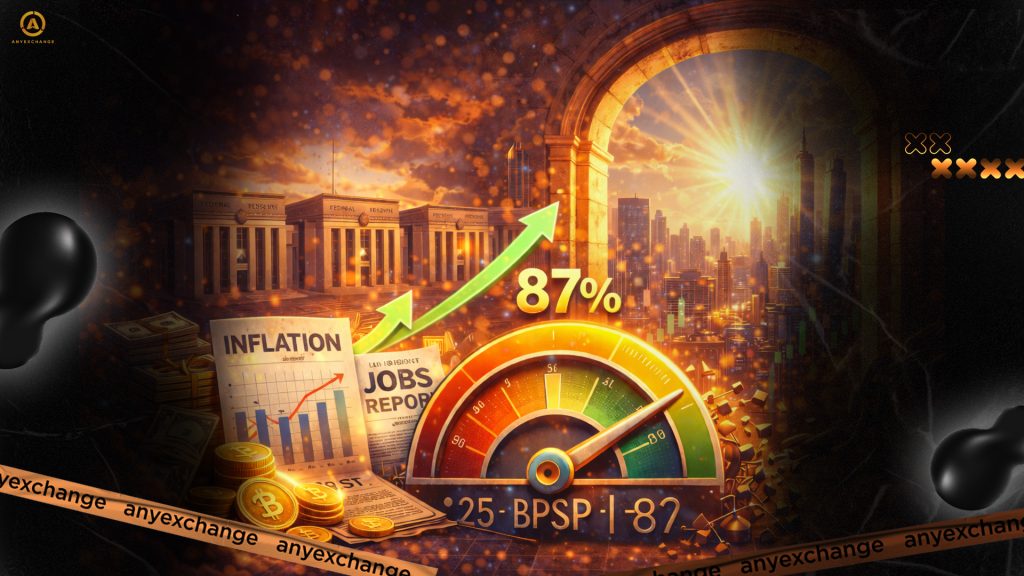
The resumption of work by federal agencies has allowed the market to once again receive complete and timely data on inflation, the labor market, and economic activity—which is critical for assessing the Fed’s next steps. Market participants have therefore begun to price in a scenario of monetary policy easing. The probability of a 25-basis-point rate cut in December was estimated at around 87%, which has boosted interest in risk assets.
Capital Inflows into Risky Assets
Easing fiscal pressure and expectations of Treasury General Account (TGA) drainage are creating conditions for capital to return to the financial systеm. We are potentially talking about hundreds of billions of dollars of additional liquidity, some of which will inevitably flow into high-risk segments. This explains why the crypto market reacts so sharply to political events. It also demonstrates how U.S. public finances affect cryptocurrencies, creating cycles of contraction and expansion in demand.
Restoring Confidence Amid the Budget Resolution
The budget compromise, albeit temporary, became an important psychological factor. It reduced systemic stress, as reflected by the decline in the VIX index, which is an indicator of expected market volatility. This indicates the effect of restoring confidence after the US crisis.
Which coins could benefit?
The market’s response to the stabilization of the budget situation in the U.S. revealed that investors are willing to take on more risk, albeit selectively. Among the assets that recovered fastest from the decline, altcoins with established infrastructure and clear applicability stand out. They have shown the market which coins benefit most from political stability.
After the November 2025 crisis ended, Zcash led in growth, gaining about 17%. XRP and Solana followed, growing by about 8%. These movements outpaced the recovery of Bitcoin and Ethereum, which moved more slowly. In other words, the growth of cryptocurrencies after the U.S. budget decision primarily affected second-tier assets, where investors were looking for asymmetric returns. At the structural level, attention is shifting toward sectors that can benefit from improved macroeconomic conditions and regulatory certainty. Among them:
- Second-layer solutions based on Bitcoin and Ethereum rollup infrastructure. These solutions are expected to benefit from scaling and growth in user activity by 2026.
- AI tokens and hybrid blockchain models that integrate machine learning and DeFi are seen as a long-term investment in the automation of financial services.
- DeFi with a focus on RWA tokenization is one of the key candidates for capital inflows amid stabilization.
- Stablecoins and payment solutions traditionally benefit from the normalization of fiscal policy and the regulatory process. The growth in transaction activity on Base and Solana confirms that Congress’s decisions impact not only investment assets but also infrastructure segments of the cryptocurrency market.
Potential risks and uncertainties
- However, the temporary decision to extend federal agency funding is only valid until January 30, 2026. This means there’s still a chance of another partial shutdown. The market is already factoring this into prices, adding to short-term volatility. An additional source of uncertainty is the confrontation between the Trump administration and the Fed leadership.
- US inflation is around 2.7%, leaving the Fed room for a pause or policy tightening. Added to this are external factors, such as geopolitical instability, the risk of a global economic slowdown, and possible signs of a recession.
Investor Strategy
According to cryptocurrency market analysts, the current market phase should be viewed as transitional. Although uncertainty has decreased, it has not completely disappeared. How can traders and investors take advantage of recent political events? The basic logic of the strategy is to avoid impulsive growth and instead work from corrections and local drawdowns against the backdrop of news about the budget, liquidity, and the Federal Reserve’s actions. Crypto investors have an opportunity after the shutdown due to the restoration of dollar liquidity and the return of interest in risky assets. In practice, this means gradually building positions with a focus on sectors that will benefit from the macro turnaround.
Key entry signals inсlude growth in trading volumes that confirms capital inflows. Additional attention should be paid to ETF decisions and the progress of crypto regulation discussions in Congress. Macroeconomic indicators, such as inflation and labor market data and Federal Reserve comments, directly affect the crypto market by shaping short-term trends and entry points.
Frequently Asked Questions (FAQ):
- Why does the end of the US shutdown affect the cryptocurrency market?
The end of the budget crisis reduces uncertainty, which directly affects capital movements. For investors, this means improved liquidity conditions and a return of interest in risky assets. The end of the US shutdown has had an impact on cryptocurrencies, manifested through increased activity, a recovery in trading volumes, and reduced pressure from defensive strategies.
- Which cryptocurrencies react most strongly to political decisions?
The largest assets are the first to react to changes in the fiscal and regulatory environment. Bitcoin and Ethereum generally reflect market trends, while altcoins often exhibit more dramatic price fluctuations.
- What does a “window of opportunity” mean for crypto investors?
It refers to a limited time period when a combination of macroeconomic and political factors creates favorable conditions for entering the market.
- What risks remain after the shutdown ends?
The threats of a new budget crisis, inflationary pressure, and corrections amid market revaluation persist. These factors could increase volatility and change market sentiment.
Conclusion
The end of the budget crisis in the US was an important signal for global financial markets. Reduced political tension, restored access to macroeconomic data, and expectations of liquidity inflows have created a more favorable backdrop for digital assets.
At the same time, however, the market remains sensitive to the fiscal and regulatory agenda. Risks associated with a potential government shutdown, inflation, and market corrections persist. This is why the current situation is perceived as a temporary phase.
Thus, we can conclude that the situation appears moderately positive in the short term. The temporary resolution of the budget issue has created tactical opportunities for investors. However, success in these conditions requires close monitoring of political and macroeconomic signals.
Thank you for your attention. Invest safely and profitably!
AnyExchange is an exchanger where you can convert cryptocurrencies at the most favorable rate and make secure money transfers around the world.